

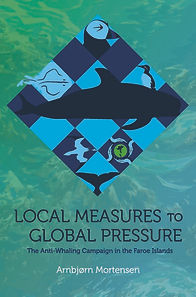
Local Measures to Global Pressure (2022)
Arnbjørn Mortensen
This book explains the history and explores arguments on both sides of the Pro & Anti-Whaling debate in the Faroe Islands.
Have you ever been curious about it ?
This book talks about whaling. It also talks about the misunderstandings inherent to a tribalist approach to activism, and the difficulties to make changes happen in the incomprehension of others.
If you've ever been curious about (or angry at) the practice of whaling in the Faroe Islands, I cannot recommend this book enough.
The author Arnbjørn Mortensen, a faroese historian, takes a very... historical approach on the culture of whaling in the Faroe Islands, explaining it's fundamental role on the birth of national consciousness as Faroese, allowing occasional meetings for centuries between people that wouldn't otherwise meet.
He also clarifies the differences between ways of whale hunting - commercial, scientific and traditional whaling are fundamentally different and don't have the same status in the Faroes.
He also adopts this historical approach on the anti-whaling campaigns globally.
As a historian, his way of describing anti-whaling campaigns and anti-whaling global sentiments is also quite interesting to read. For a historian, and generally in social sciences, things are not Good nor Bad, they are a social construct. They exist. They can be perceived as Good or Bad. They can also change, under the influence of people, philosophical movements, organizations...
He therefore analyses the concept of a Whale in history, shows how it evolved (very quickly, in retrospect!) in the global mind from a product like others to be hunted, to what he and others call the "Super-Whale", a vision of whales as more than different species of marine animals but as One anthropomorphic, intelligent form of life that has to be protected above others, becoming a symbol of environmental activism in the 70's.
On this point, I have to speak about a passage of this book because it makes my brain explode.
So, in this chapter about "The making of a whale", Mortensen speaks about a specific person that would have a huge influence on the anti-whaling movements worldwide : Dr. John C. Lily.
Ok so, Lily was working in the mid 50's to early 60's at Marineland, an oceanarium located in Florida. Interestingly, Marineland started as early as 1940, way ahead of it's time, to use anthropomorphism to market dolphins and whales to the public, to bring more people in.
Well, what was Lily working on during his time ? Oh, he was conducting research on dolphins brains on the behalf of the U.S. military, in the hope of developing Cold War brainwashing and "operant control".
His methods involved potentially the killing of said dolphins.
Now, according to Mortensen, Dr. Lily heard the cry of a dolphin during one of these experiments, and persuaded that the dolphin was trying to communicate with him, switched entirely his field of studies to dolphin and whale intelligence. He wrote about the "godlike" intelligence of sperm-whales and such.
Then, having written many books on the subject of whale and dolphin brains, he naturally became the reference for many people.. Including filmmakers and writters ! That's how Lily became scientific advisor for movie hits of the 60's, first of all Flipper (1963), then The day of the Dolphin (Novel 1967, Film 1973), and others.
These films, books and stories inspired another generation of scientists to study whales, another generation of artists to have their take on whale intelligence (see there the album "Songs of the Humpback Whale" by Payne & McVay, Lily's assistant from 61 to 63), which are in turn also going to inspire a new wave of activists to demonstrate their love for whales in anti-whaling campaigns.
For me, this anecdotes really show how the anti-whaling movement was co-constructed by people building on top of each-other.
On a side note, Dr. John C. Lily is also the guy that invented the deprivation tank, a special water tank to experience sense deprivation, which he was using often, also often on LSD.
What a colorful character, right ?
In the chapter describing faroese relationship towards whaling, the author explains not only about the traditional and communitarian aspects of it, but also the fact that stocks of pilot whales (the specific type of whale hunted in the Faroes) are stable, even though the main part of the killings are not due to faroese hunting but are either natural causes (eaten by other animals in the ocean), or are byproducts of intensive fishing and ocean pollution by Western countries - the same nations that are the most vocal opponents to whaling on the international stage. This irony is perceived as unfair by most faroese.
Another argument brought up by the faroese is the hypocrisy of criticism towards whale hunting coming from meat consumers. Mortensen quotes an article in a faroese journal saying :
The question is what is more morally reprehensible, to eat pilot whale, which has lived it's entire life in the ocean and who had plenty of opportunities not to end up in a Faroese stew, or to keep pigs and cattle locked up their entire lives and who only have one purpose in their lives: to become food for humans.
In the end, Mortensen doesn't resolve any conflict, but explains why this conflict isn't resolved already.
The different parts in this conflict don't speak about the same issue, don't have the same framework.
Environmental activists, conceptualizing whales as "above human" beings, cannot understand what they perceive as barbaric against an highly intelligent creature.
Faroese people tend to see whales and themselves as part of the natural food chain, whales eating other beings and being eaten by Faroese people when they adventure themselves close to these islands.
Ironically again, anti-whaling campaigns got a unexpected allies in the late 2000's : Pál Weihe & Høgni Debes Joensen. Both Faroese, both pro-whaling, these scientists advised against whale meat consumption on medical grounds : being on the top of the food chain in the ocean, pilot whales are apparently full of mercury and can be dangerous for humans on the long term...
The last chapter is dedicated to Local Measures taken by the Faroese to respond nonetheless to the international (and internal) critique.
Less harmful tools and weaponry has been implemented to minimize animal suffering; surveys monitoring the numbers of pilot whales are held periodically; information campaigns were also held to try to bridge the "misunderstanding gap" between activists and Faroese people; the Faroe Islands now also takes part in regulations towards whaling by participating to international whaling organizations...
A great read, all in nuances, very informative.